This report presents a detailed elaboration of the development of a system for the analysis and monitoring of Three Phase systems using Arduino Uno and LabView environment. In this report, the use of LabView software and microcontroller like Arduino Uno for computer aided data acquisition is implemented for real time monitoring of electrical parameters like the phase angles, Peak Voltage, etc also demonstrating the core principles of altering current (AC) in star (Y) configuration, with 120-degree phase shift. It also inculcates the significance of three-phase systems in terms of power generation, transmission, and industrial distribution. Utilizing LabVIEW software to meticulously document the implementation of voltage and current measurements, which are visually depicted through polar plots and X-Y coordinate graphs, resulting in a comprehensive evaluation of the system’s performance.
1.Theory 🔗
Witness to history, the transition in the electrical systems such as from DC to polyphase AC is led by many great pioneers, including Nikola Tesla, Charles Steinmetz and William Stanley[1]. In today’s increasingly interconnected world, the need for efficient and reliable electronic devices along with their power distribution has become paramount. In electrical terminologies, phase refers to the distribution of load [2].
Power Supplies can be single or three phase depending on copious aspects as amount of power needed. In single phase two-wires - one phase or live wire- are present ideal for domestic utilization, whereas in three phase systems, three phase or live wires are present ideal for industrial utilization [2].
In a three-phase system the current passes through three wires which are 120 degrees out of phase to each other [2]. This system uses three wires for generation, transmission and distribution. The sum of line currents is equal to zero when fed balanced and linear loads [3]. This power supply can transmit three times as much power as a single-phase system therefore it can be said that three single phase systems can be implemented using a single three phase system [2].
The generator gives three phase voltages with equal frequency and magnitude [3]. Typically, 50 or 60 Hz depending upon the various continents and countries [3]. The phase difference creates fascinating dynamics, where the voltage peak of one conductor is reached a third of a cycle after another conductor’s peak and a third of a cycle before the peak of the remaining conductor.[3]
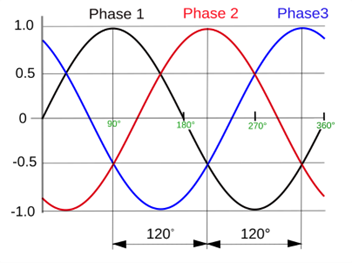
The 120 degrees phase shift is necessary for proper working of the system [3]. Normalized waveforms are depicted in Figure 1 which further illustrates the instantaneous voltages throughout a single cycle of a three-phase system. As time moves to the right, the phase order proceeds as 1-2-3, repeating cyclically in sync with the power system’s frequency [4].
1.1 Generation and Distribution: 🔗
Three-phase power refers to an electrical system that has three voltage or current curves. While we are used to thinking of electric voltage as being constant (for instance, receiving 120V service) in reality the voltage of an electric line is continually fluctuating from positive to negative values. A three-phase system delivers power along three wires, with each wire having its own voltage curve.
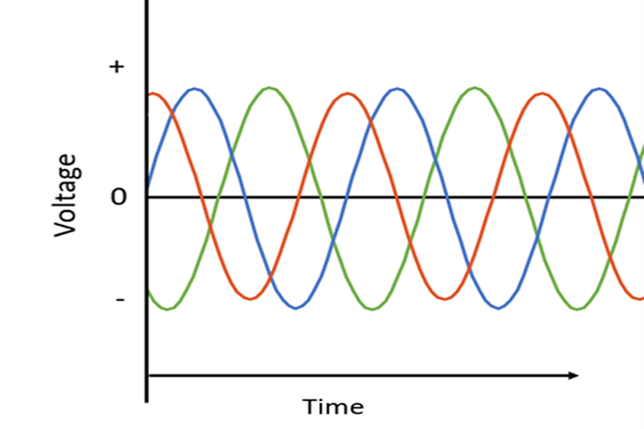
Three-phase power is generated by spinning a magnet inside three separate independent coils of wire. Each phase wire of a three-phase distribution line is connected to one of the coils.[8] The three separate independent coils of wire produce three separate independent voltages with different timing, as shown here. Notice that there are three single-phases of power: phase A shown by the blue line, phase B shown by the green line, and phase C by the red line. Phases A, B, and C are mirror images of each other, except that their time sequence is staggered. So, when phase A is going through zero, phases B and C are not. Likewise, when phase A is at its maximum value, in either direction, phases B and C are not.[8]
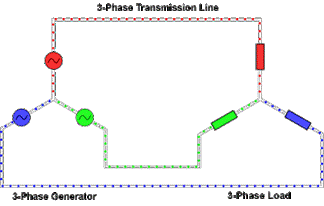
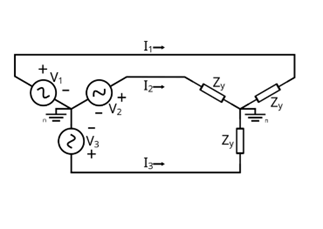
The voltage seen by the load will depend on the load connection; for the wye case, connecting each load to a phase (line-to-neutral) voltages gives
I1 = (V_1 )/Z_Total angle (-θ),
I2 = (V_2 )/Z_Total angle (-120°-θ),
I3 = (V_3 )/Z_Total angle (120°-θ)
Where ZTotal = ZLN + ZY and the phase angle difference between voltage and current of each phase is not necessarily 0 and depends on the type of load impedance, ZY. Inductive and capacitive loads will cause current to either lag or lead the voltage. However, the relative phase angle between each pair of lines (1 to 2, 2 to 3, and 3 to 1) will still be −120°.[3]
In star connection, the line voltage is √3 times of phase voltage. Line voltage is the voltage between two phases in three phase circuit and phase voltage is the voltage between one phase to the neutral line. And the current is same for both line and phase. It is shown as expression below [4]
Eline = √3EPhase
Iline = IPhase
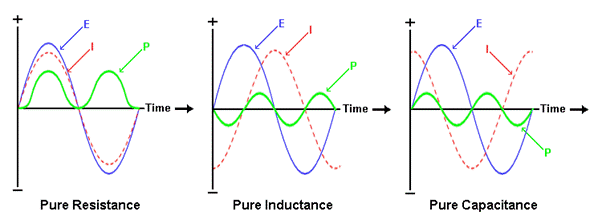
AC voltage and currents if shown as sinusoidal wave forms. We can have an AC voltage over a resistor, the current will be in the same phase. If we pass the same voltage over an inductor or capacitor, the current will be out of phase, because these two devices need time for charging and discharging. Specifically, an inductive circuit will cause the current to lag behind the voltage, and a capacitive circuit will cause the current to lead the voltage. A diagram visually explaining this sometimes can be easier to understand (E is the voltage waveform, I is the Current Waveform, and P is power).
2. Setting up a test System 🔗
2.1. Introduction to LabVIEW 🔗
LabVIEW is a graphical programming environment that enables you to accelerate the development of test systems in unique ways, such as through an intuitive programming approach, the integration of any measurement device, and through fully integrated user interfaces.[6] The LabVIEW simulation is a useful tool for users to become acquainted with the instrument’s operation and to test various scenarios without the requirement for physical hardware.
In our project LabVIEW provides us a front panel as Graphical interface by seamlessly integrating user interface creation. Program subroutines in LabVIEW are termed virtual instruments (VIs), each comprising three elements: block diagram, front panel, connector pane. The connector pane
symbolizes the VI in the block diagrams of another sub–VIs. The front panel incorporates controls for input and indicators for displaying output results. The back panel, functioning as a block diagram, hosts the graphical source code, and objects on the front panel become terminals on the back panel.
2.2. Experimental Setup 🔗
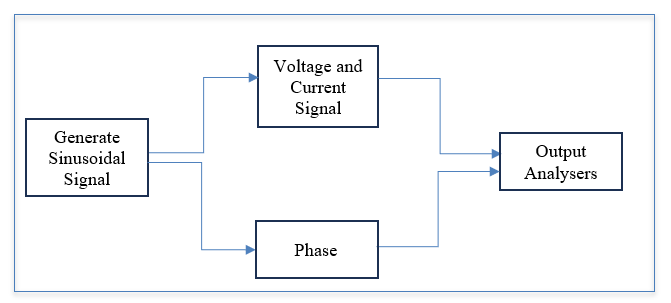
The measurement system implemented in LabVIEW software has the below mentioned block diagram. It consists of various functionalities namely, Data Acquisition, Voltage and Current measurement, phase difference and graphical representation of system and measurements.
3. Designing System in LabVIEW 🔗
3.1. Voltage, Current and Phase 🔗
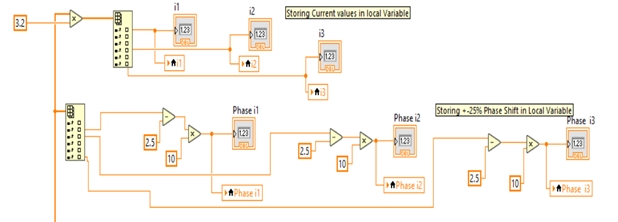
We have the constant amplitude of 3 voltages which is 240 volts and 120 degrees phase difference. For our current i1, i2, i3 and phase P1, P2, P3 we need analog values which are obtained using Arduino UNOs analog pins A0, A1, A2, A3, A4, A5.
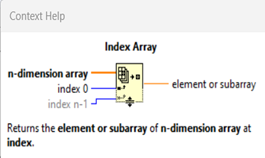
We use an index array to club all the analog inputs from the Arduino UNO and the three current values from analog inputs are multiplied by a factor of 3.2 in order to make it 16A and then stored in a local variable which is further passed while generation of a signal. Likewise, we store three analog values as phase but with a margin of 25%. Refer figure 7.
3.2. Signal Generation 🔗
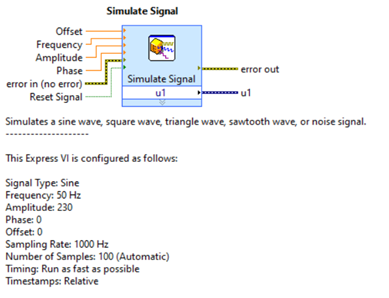
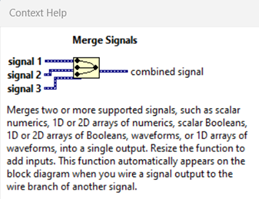
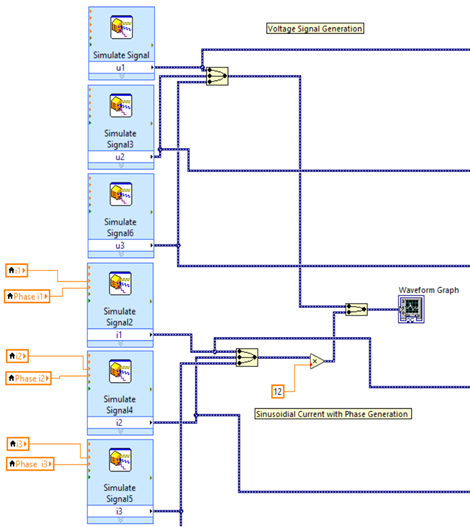
Using the signal generator, three voltages and three current signals are generated. Where in voltage 1, the signal type is Sine, frequency 50Hz, amplitude 230 and phase 0. In voltage 2, the signal type is Sine, frequency 50Hz, amplitude 230 and phase 120 degrees. In Voltage 3, the signal type is Sine, frequency 50Hz, amplitude 230 and phase 240 degrees. These three generated waves are then merged together using a signal merger (see figure 9). Similarly, three current signals are generated using the variables passed as the parameters which we created in the beginning by reading analog inputs from Arduino. These three currents are also merged together using a signal merger and then both merged signals are again passed through a single signal merger and the output is passed to the waveform graph (see figure 10) to analyze the output.
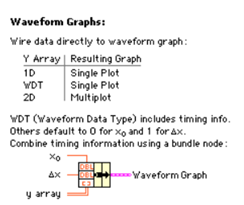
These generated signals are then passed to Tone measurements (see figure 12 and 13) and then the scalar component is further passed to an indicator which lets us know the real time values.
3.3. Signal Toning 🔗
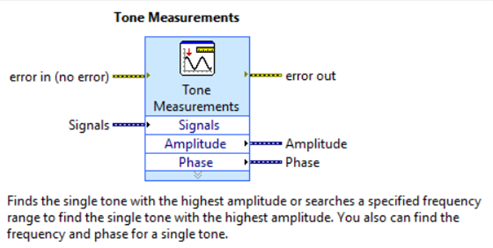
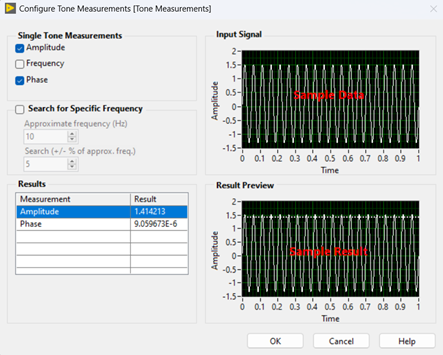
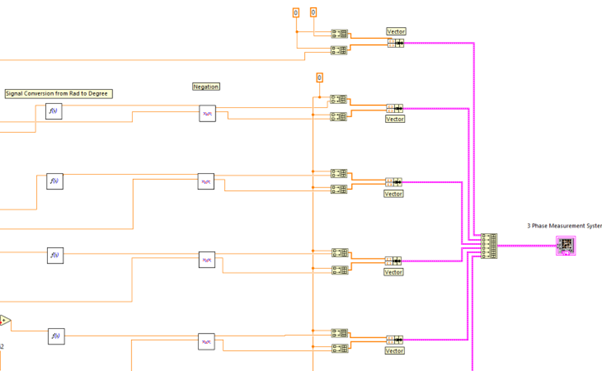
Furthermore, the signal is converted from radians to degrees following with a negation, it is passed to a vector array which get merged and the data is been plotted using waveform Graph. (see figure 14)
3.4. Signal Conversion and Negation 🔗
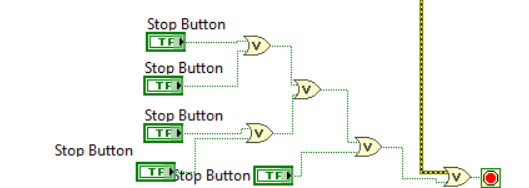
Also, on every front panel page there is a stop button which is in a OR Logic (see figure 15)
4. Results 🔗
4.1. Real Time data Acquisition simulation of analog inputs 🔗

Figure 16 shows the real time acquired analog inputs from analog pins of Arduino Uno. This is the first step of our test system where we check the inputs are acquired or not. According to the Microcontroller’s analog pin numbers we have to choose the channels.
4.2. Zieger Diagram 🔗
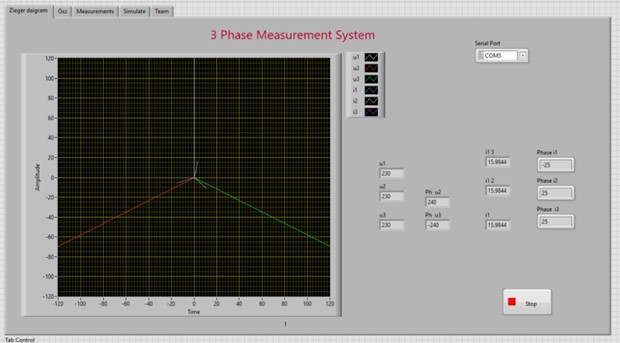
In the figure 17, when selected a right COM for obtaining serial communication with microcontroller, a polar plot is displayed along with the numerical indicators which indicates the real time values for currents and voltages along with the phase.
4.3. Oscilloscope 🔗
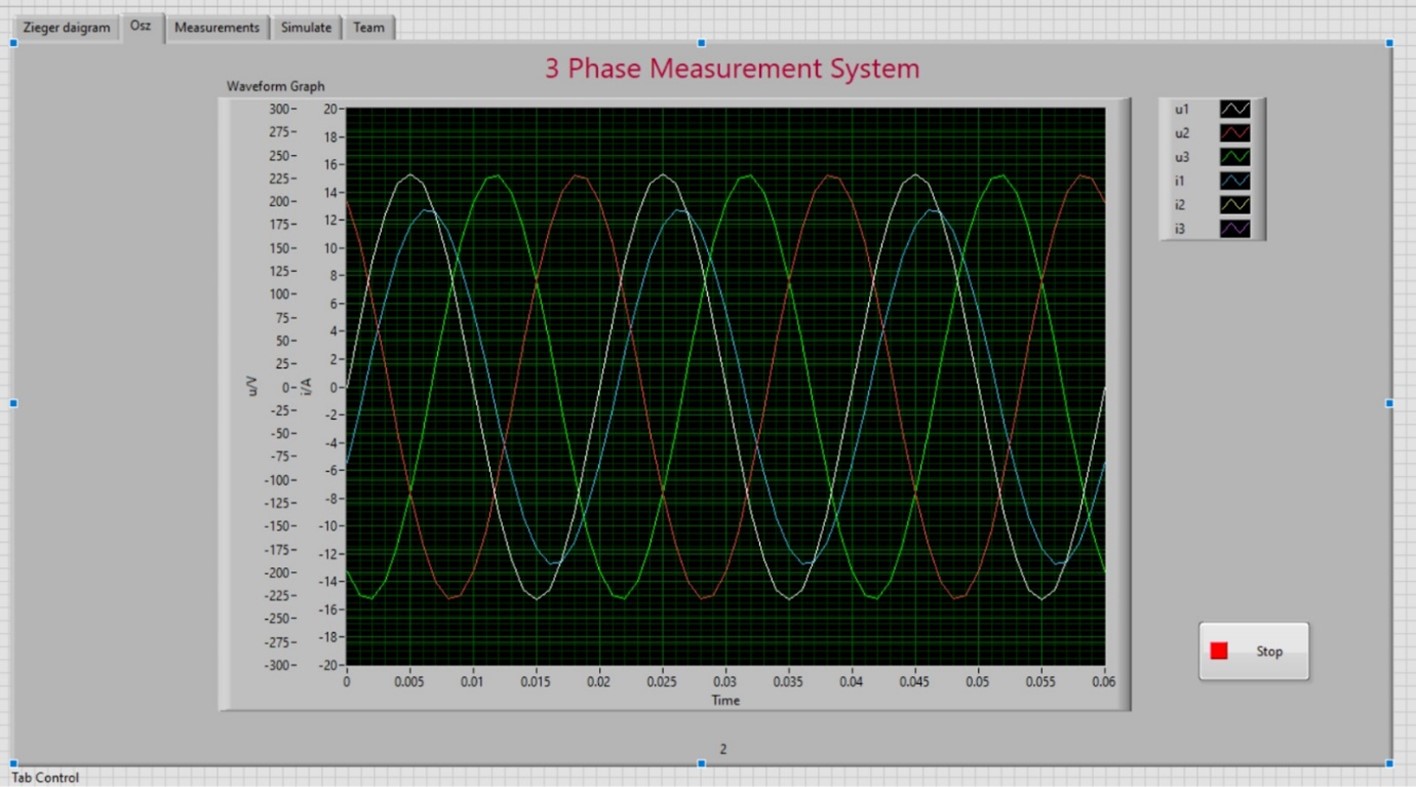
In order to analyze the output, an oscilloscope is required where voltages can be plotted along with the currents, giving a sinusoidal waveform.
4.4. Measurement Indicators 🔗
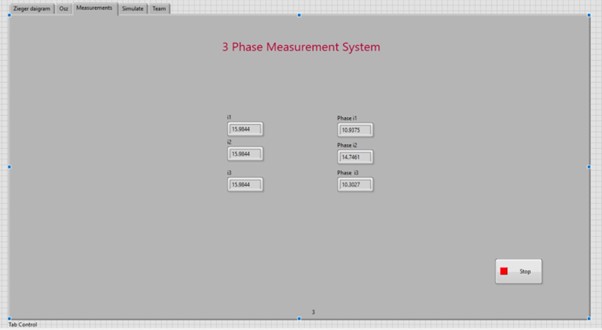
A front panel also requires a tab where only numerical values of the three-phase system are required in order to analyze it numerically.
5. Conclusion 🔗
It can be said that an automated test system for analysis and monitoring three phase using LabVIEW is successfully developed. The integration of LabVIEW’s graphical programming environment with Arduino Uno helped to acquire real time data and analyze parameters such as phase angles, voltages and currents. This portrays the effectiveness of test system and showed the importance of precise monitoring and control for efficiency. The simulation provides a platform for evaluating system performance.
References 🔗
[1] https://circuitglobe.com/three-phase-system.html
[2] https://www.fluke.com/en/learn/blog/power-quality/single-phase-vs-three-phase-power\
[3] https://en.wikipedia.org/wiki/Three-phase_electric_power
[4] Three Phase Circuit | Star and Delta System | Electrical4U
[5] https://www.allaboutcircuits.com/technical-articles/an-intro-to-power-systems-and-reactive-power/